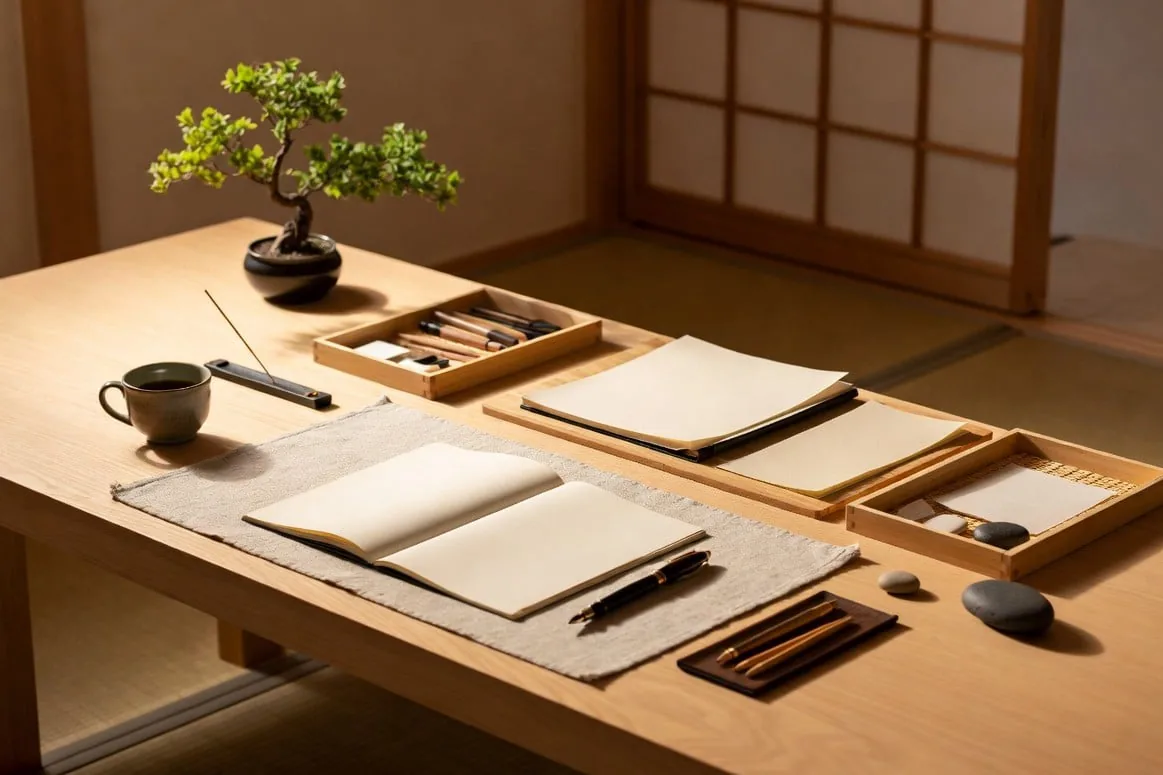
Desk Organization for Deep Focus Days
Not every workday demands the same desk organization. On deep focus days—when you need three uninterrupted hours of writing, coding, or designing—your usual setup will fail you. Standard home office setup advice assumes variety and quick task switching. But deep focus requires the opposite: extreme reduction, predictable tool placement, and zero visual surprises. Before a focus block, remove everything that does not serve the single task ahead. Your phone goes into another room. Your notebook stays closed unless you are actively writing in it. Only three items remain: your screen, your input device, and one drink.
The first rule of focus-oriented desk organization is the "one-hand reach." Every tool you might need should be reachable without moving your torso. Place your water on the dominant side, your spare pen on the nondominant side, and your phone facedown or away entirely. If you need a reference document, print it or open it in full-screen mode. Do not split your screen between work and distractions. A deep focus home office setup looks almost empty to an outsider. That emptiness is the point. Workspace comfort here means having nothing that demands your attention except the task itself.
Now address sound and airflow. Deep focus requires stable background conditions. If you live in a noisy neighborhood, use a white noise playlist at the same low volume every session. If you feel too warm, aim a small fan at your torso, not your face. Sudden temperature changes break concentration. Before you begin, spend one minute adjusting your chair and screen so your body feels neutral. Physical discomfort is the number one focus killer, even in a minimalist desk organization system. Your spine, wrists, and eyes should feel nothing at all. When your body is silent, your mind can roar.
The second rule is time-based zoning. For the first ninety minutes of your focus block, do not reorganize or clean anything. Resist the urge to perfect your home office setup once you start working. That urge is often procrastination in disguise. Instead, make a small "parking lot" area—a single sticky note or a separate text file—where you dump any unrelated thought that arises. Do not act on those thoughts. Just write them down and return to your task. This technique turns desk organization from a physical practice into a mental one. Your desk stays still so your brain can move.
After ninety minutes, you earn a five-minute reset. Stand up, stretch your neck, and rehydrate. Then look at your desk with fresh eyes. Did any tool drift out of the one-hand zone? Did a low battery notification appear? Use this pause to restore your workspace comfort before the next block. Remove empty cups, close unused tabs, and wipe down sweaty contact points on your mouse and keyboard. This micro-reset takes less than sixty seconds but doubles your endurance for the next ninety-minute session. A deep focus home office setup is not static—it breathes with you.
Over time, you will learn which small objects actually support your focus and which only pretend to. A single physical timer can help. A stack of sticky notes usually distracts. Be honest with yourself during weekly reviews. The goal of desk organization for deep focus is not to look productive. It is to remove every micro-friction between you and absorption. When your home office setup fades into pure background, you enter flow without effort. And that is the highest form of workspace comfort—a desk you forget exists because it serves you so perfectly that you notice nothing at all except your work.